Procedure 25 – Personal Protective Equipment
REV. 9
Revision History
Revision
1
2
3
4
5
6
7
8
9
Date
04-01-91
10-21-94
04-24-95
10-19-00
03-26-03
12-15-09
03-16-12
09-04-15
09-14-16
Comments
General Revision
General Revision
General Revision
General Revision
General Revision and added electronic links
General Revision
General Revision; reformat and renumbered procedure; revised Table E-1
Added cut-resistant gloves to the definitions and to section 10.0
Revised Sections 6.0 (Training), 7.0 (Head Protection), 10.0 (Hand Protection), and 11.0 (Foot Protection)
1.0 PURPOSE
The purpose of this procedure is to provide written instructions on the requirements for personal protective equipment.
2.0 RESPONSIBILITY
It is the responsibility of the employer to select, provide, and require the wearing of the appropriate personal protective equipment in all operations where there is an exposure to hazardous conditions that have not been effectively reduced by engineering controls.
3.0 REFERENCES
29 CFR 1926.28
29 CFR 1926.100-107
4.0 DEFINITIONS
4.1 Contaminant – Any material that by reason of its action upon, within, or to a person is likely to cause physical harm.
4.2 Cut-resistant gloves – gloves having a minimum ANSI cut-resistance rating of 3.
4.3 Lanyards – A rope, suitable for supporting one person. One end is fastened to a safety belt or harness and the other end is secured to a substantial object or a safety line.
4.4 Lifeline – A rope suitable for supporting one person, to which a lanyard or harness is attached.
4.5 Radiant energy – Energy that travels outward in all directions from its sources.
4.6 Safety harness – A device, usually worn around the waist, chest, and legs, which, by reason of its attachment to a lanyard and lifeline or a structure, will prevent a worker from falling.
5.0 PROCEDURE
5.1 To adequately determine the appropriate personal protective equipment a PPE assessment must be conducted. A pre-job Job Safety Analysis (JSA) or equivalent will serve as a PPE assessment. The JSA or equivalent shall identify task steps, hazards, and appropriate protective measures. This document must be signed and dated by the supervisor and reviewed by the Superintendent.
5.2 The JSA or equivalent will discuss the necessary control measures to be implemented to address the specific hazards.
5.3 The Job Safety Analysis or equivalent shall also determine the necessary PPE for the specific task. (Note: Engineering controls shall be considered primary protection and PPE shall supplement the engineering controls where needed.)
5.4 PPE shall be selected that fits each affected employee.
5.5 PPE shall be inspected prior to the issue and prior to each use.
5.6 Damaged or defective PPE shall be removed from service immediately.
6.0 TRAINING
6.1 The site manager or his qualified designee shall provide training for each employee who may be required to wear PPE.
6.2 Training will include at a minimum: when it is necessary; what kind/type is necessary; steps to properly don, doff, adjust and wear PPE; the limitations of the PPE; the proper care, maintenance, useful life & disposal of PPE.
6.3 Retraining shall be conducted when the workplace changes, making an earlier training obsolete; the type of PPE changes; or when the employee demonstrates lack of use, improper use, or insufficient skill or understanding.
6.4 Employee training on PPE must be documented and include the employee’s name, dates of training, and certification subject.
7.0 HEAD PROTECTION
7.1 All employees shall be required to wear approved hard hats in areas where possible head injuries could occur or are required by site or project rules. Hard hats shall be worn with the bill facing forward unless approved by the onsite safety representative due to work area safety restrictions. These areas include but are not limited to the following:
7.1.1 All fieldwork areas
7.1.2 Work shops
7.1.3 Warehouses
7.2 Helmets for the protection of employees against impact and penetration of falling and flying objects shall meet the specifications contained in American National Standards Institute, Z89.1-1969.
7.3 Helmets for the head protection of employees exposed to high voltage electrical shock and burns shall meet the specifications contained in American National Standards Institute Z89.2 – 1971.
7.4 Routinely inspect hard hats for dents, cracks, or deterioration. Replace after a heavy blow or electrical shock. Maintain in good condition.
8.0 HEARING PROTECTION
Approved earplugs are required when working in high noise areas as per the guidelines listed in 29 CFR 1926.52. Reference Occupational Noise Exposure EHS Procedure #026.
9.0 EYE AND FACE PROTECTION
9.1 Approved safety glasses with side shields shall always be worn on the job site where possible eye injuries could occur or are required by site or project rules.
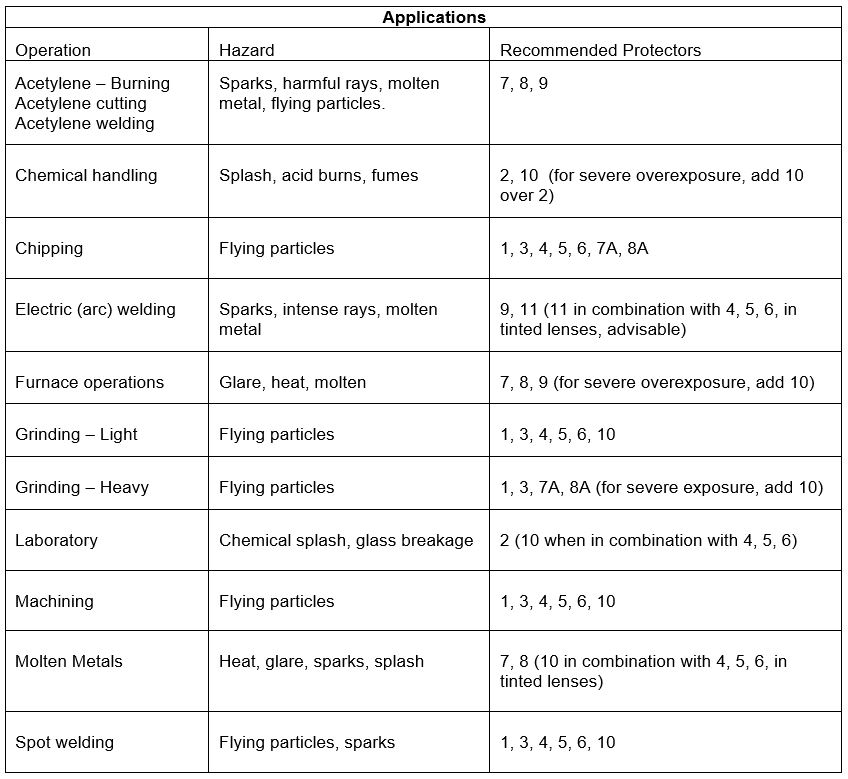
9.2 Table E-1 should be used as a guide in the selection of face and eye protection for the hazards and operations noted.
9.2.1 When the use of face shields is required, an appropriate face shield shall be utilized that allows the face shield to be worn with a hardhat. This shall include welding shields as well as face shields used for grinding with power tools.
9.3 Face shields and safety glasses or goggles shall be worn for chipping, grinding, or sawing
9.4 During sandblasting, a supplied-air blast hood with a CO monitor is required for employee safety.
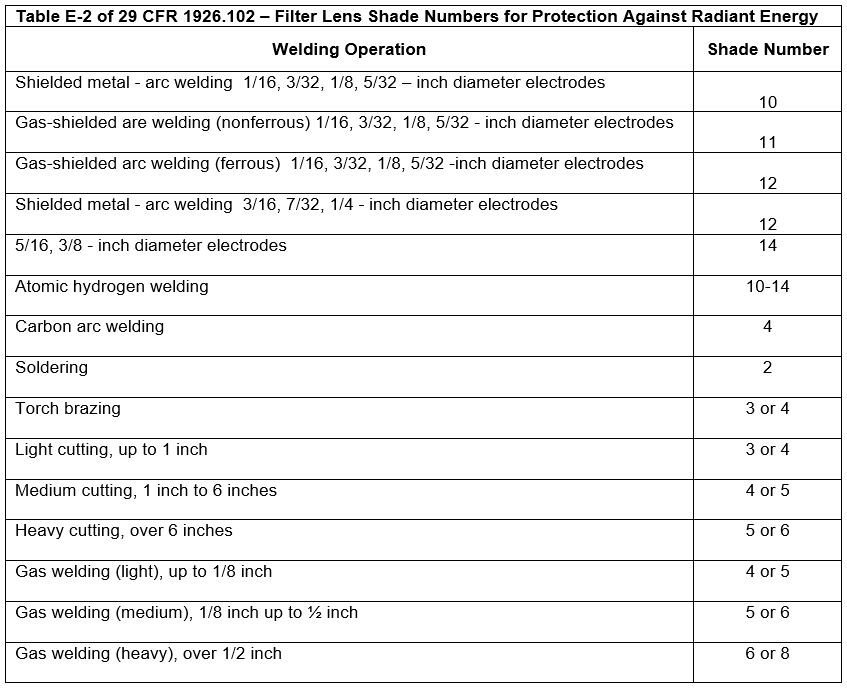
9.5 Protection against radiant energy – for eye protection during welding, burning, or cutting refer to Table E-2 of 29 CFR 1926.102 (D) for proper shade number for filter lenses.
Table E-1 of 29 CFR 1926.102 – Eye and Face Protector Selection Guide
1. GOGGLES, Flexible Fitting, Regular Ventilation
2. GOGGLES, Flexible Fitting, Hooded Ventilation
3. GOGGLES, Cushioned Fitting, Rigid Body
4. * SPECTACLES, Metal Frame, with Side shields
5. * SPECTACLES, Plastic Frame, with Side shields
6. * SPECTACLES, Metal-Plastic Frame, with Side shields
7. ** WELDING GOGGLES, Eyecup type, Tinted Lenses
7A. CHIPPING GOGGLES, Eyecup type, Clear Safety Lenses
8. ** WELDING GOGGLES, Cover spec Type, Tinted Lenses
8A. CHIPPING GOGGLES, Cover spec Type, Clear Safety Lenses
9. ** WELDING GOGGLES, Cover spec Type, Tinted Plate Lens
10. FACE SHIELD (Available with Plastic or Mesh Window)
11. ** WELDING HELMETS
* Non-side shield spectacles are available for limited hazard use requiring only frontal protection
** See Table E-2, Filter Lens Shade Numbers for Protection Against Radiant Energy
10.0 HAND PROTECTION
10.1 Suitable cloth or leather gloves should be worn while performing any work that could present a hazard such as sandblasting, grinding, chipping, or handling rough material.
10.2 Plastic or rubber-coated gloves are required when handling solvents, acids, or chemically treated material.
10.3 Cut-resistant gloves (ANSI cut-resistance rating of 3 or higher) are required to be worn when performing cutting tasks and handling potentially sharp objects.
10.4 Gloves should fit snugly and be right for the job.
11.0 FOOT PROTECTION
Approved safety shoes or boots with slip-resistant and puncture-resistant soles shall always be worn and shall meet the requirements of ANSI Z41.1-1967.
NOTE: The type of protective shoes required at your specific facility shall be worn as a minimum. Steel-toed ANSI approved footwear is required for all job tasks that require the lifting of materials.
12.0 SAFETY HARNESSES, LIFELINES, AND LANYARDS
12.1 Lifelines, safety harnesses, and lanyards shall be used only for employee safeguarding. Any lifeline, safety harness or lanyard subjected to in-service loading shall be immediately removed from service and shall not be used again for employee safeguarding.
12.2 Lifelines shall be secured above the point of operation to an anchorage or structural member capable of supporting a minimum dead weight of 5,400 pounds.
12.3 For normal lifeline application, a minimum of 3/4 inch manila rope or equivalent, with a minimum breaking strength of 5,400 pounds shall be used.
12.4 Safety harness lanyards shall be a minimum of 1/4-inch nylon, or equivalent, with a maximum length to provide for a fall of no greater than 6 feet. The rope shall have a nominal breaking strength of 5,400 pounds.
12.5 Safety harnesses shall be worn and tied off to independent lifelines when working from elevated areas under the following conditions:
12.5.1 The roof pitch equals or exceeds 4 in 12.
12.5.2 The work requires men closer than 4 feet from a roof edge without parapets.
12.5.3 Two-point suspension scaffolds or stages are in use.
12.5.4 Scaffolds with incomplete handrails and docking are used.
12.5.5 Ladders are placed near the edge of a roof or floor opening.
12.5.6 Elevated work where no protection is available to prevent the worker from falling.
12.6 Safety harnesses, lanyards, and lifelines shall be inspected prior to each use for the following conditions:
12.6.1 Inspect safety harnesses for excessive wear, cuts, stitching failure, holes, alterations, and acid or heat exposure.
12.6.2 Inspect hardware for missing parts, alterations, deformity, wear, and heat or acid exposure.
12.6.3 Inspect lanyards and lifelines for excessive wear, fraying, cuts, alterations, heat, or acid exposure and for specific requirements, such as the size rope required.
12.6.4 Damaged or defective fall protection shall not be used. Damaged or defective fall protection shall be destroyed immediately.
12.7 See also Fall Protection EHS Procedure 045 for additional requirements.
13.0 ADDITIONAL REQUIREMENTS
13.1 Types and specific personal protective equipment sometimes vary from plant to plant. Any specific personal protective equipment required at a facility shall be utilized in addition to the requirements of this procedure.
13.2 Defective and damaged personal protective equipment shall not be used. PPE when provided will be used and maintained in a sanitary and reliable condition.
13.3 Employee-owned PPE will be inspected for maintenance and sanitation and will be evaluated for its adequacy by the on-site competent person. Nitro Construction Services will assure proper training for the use of the employee-owned PPE.
13.4 Defective or damaged PPE shall not be used.