Procedure 26 – Occupational Noise Exposure
REV. 7
Revision History
Revision
Date
Comments
1
04-18-95
Initial Issue
2
10-23-00
General Revision
3
03-26-03
General Revision and added electronic links
4
12-15-09
General Revision
5
03-16-12
General Revision; reformat and renumbered procedure
6
04-11-12
Added requirements for audiometric testing, hearing protectors, and recordkeeping.
7
09-14-16
Added requirement for instruments to be calibrated, employee notification of noise monitoring and ensuring the proper fit of hearing protection
1.0 PURPOSE
The purpose of this procedure is to establish guidelines for exposure to occupational noise and provisions for occupational hearing protection.
2.0 RESPONSIBILITY
The site manager or his qualified designee shall be responsible for the implementation of the requirements set forth in this procedure.
3.0 REFERENCES
29 CFR 1926.52
29 CFR 1910.95
4.0 PROCEDURE
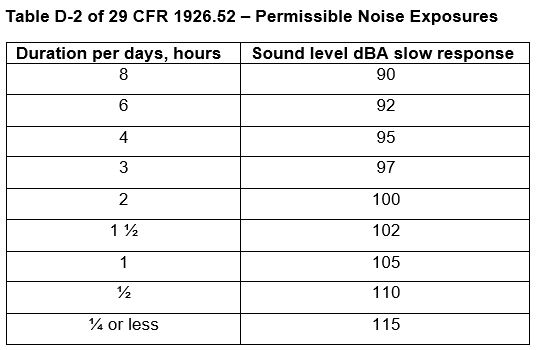
4.1 Where employees may be potentially exposed to time-weighted average noise levels more than chart D-2 (below), OSHA has determined that an effective hearing conservation program shall be implemented and shall consist of the following elements:
4.1.1 Monitoring of employee noise exposure to determine where noise hazards exist. Instruments used to measure employee noise exposure shall be calibrated to ensure measurement accuracy.
4.1.1.1 Nitro shall notify each employee exposed at or above the 8-hour time-weighted average of 85 decibels of results of the monitoring.
4.1.2 The implementation of engineering controls, work practices, and administrative controls to protect employees from excessive noise.
4.1.3 Provision for providing employees hearing protection with an adequate noise reduction rating for the noise level of exposure. This provision shall also include a reevaluation of control measures when noise levels change. 85db may not be exceeded without regard to the use of hearing protection, over an 8-hour period.
4.1.4 Provision for employee training and education on noise hazards and appropriate protective measures. The training shall be updated consistent with changes in PPE and work processes. Training at a minimum shall be updated annually.
5.0 AUDIOMETRIC TESTING
5.1 Nitro shall establish and maintain an audiometric testing program as provided in this paragraph by making audiometric testing available to all employees whose exposures equal or exceed an 8-hour time-weighted average of 85 decibels.
5.2 The program shall be provided at no cost to employees.
5.3 Audiometric tests shall be performed by a licensed or certified audiologist, otolaryngologist, or other physicians, or by a technician who is certified by the Council of Accreditation in Occupational Hearing Conservation, or who has satisfactorily demonstrated competence in administering audiometric examinations, obtaining valid audiograms, and properly using, maintaining and checking calibration and proper functioning of the audiometers being used.
5.4 Baseline Audiogram
5.4.1 Within 6 months of an employee’s first exposure at or above the action level, Nitro shall establish a valid baseline audiogram against which subsequent audiograms can be compared.
5.4.2 Testing to establish a baseline audiogram shall be preceded by at least 14 hours without exposure to workplace noise. Hearing protectors may be used as a substitute for the requirement that baseline audiograms be preceded by 14 hours without exposure to workplace noise.
5.4.3 Nitro shall notify employees of the need to avoid high levels of non-occupational noise exposure during the 14-hour period immediately preceding the audiometric examination.
5.5 Annual Audiogram
5.5.1 At least annually after obtaining the baseline audiogram, Nitro shall obtain a new audiogram for each employee exposed at or above an 8-hour time-weighted average of 85 decibels.
5.5.2 Each employee’s annual audiogram shall be compared to that employee’s baseline audiogram to determine if the audiogram is valid and if a standard threshold shift has occurred.
5.5.2.1 A Standard threshold shift is a change in hearing threshold relative to the baseline audiogram of an average of 10 dB or more at 2000, 3000, and 4000 Hz in either ear.
5.5.3 If the annual audiogram shows that an employee has suffered a standard threshold shift, Nitro may obtain a retest within 30 days and consider the results of the retest as the annual audiogram.
5.6 Follow-up Procedures
5.6.1 If an employee’s audiogram indicates a standard threshold shift has occurred, the employee shall be informed of this fact in writing within 21 days of the determination.
5.6.2 Unless a physician determines that the standard threshold shift is not work-related or aggravated by occupational noise exposure, Nitro shall ensure that the following steps are taken when a standard threshold shift occurs:
5.6.2.1 Employees not using hearing protectors shall be fitted with hearing protectors, trained in their use and care, and required to use them.
5.6.2.2 Employees already using hearing protectors shall be refitted and retrained in the use of hearing protectors and provided with hearing protectors offering greater attenuation if necessary.
5.6.2.3 The employee shall be referred for clinical audiological evaluation if additional testing is necessary or if Nitro suspects that a medical pathology of the ear is caused or aggravated by the wearing of hearing protectors.
5.6.2.4 The employee is informed of the need for an Otological examination if a medical pathology of the ear that is unrelated to the use of hearing protectors is suspected.
5.7 Hearing Protection
5.7.1 Nitro shall make hearing protectors available to all employees exposed to an 8-hour time-weighted average of 85 decibels or greater at no cost to the employees. Hearing protectors shall be replaced, as necessary.
5.7.2 Nitro shall provide training in the use and care of all hearing protectors provided to the employees.
5.7.3 Nitro shall ensure proper initial fitting and supervise the correct use of all hearing protectors.
5.8 Training program
5.8.1 Nitro shall train each employee who is exposed to noise at or above an 8-hour time-weighted average of 85 decibels.
5.8.2 The training program shall be repeated annually for each employee included in the hearing conservation program. Information provided in the training program shall be updated to be consistent with changes in protective equipment and work processes.
5.8.3 Nitro shall ensure that each employee is informed of the following:
5.8.3.1 The effects of noise on hearing.
5.8.3.2 The purpose of hearing protectors, the advantages, disadvantages, and attenuation of various types, and instructions on selection, fitting, use, and care; and
5.8.3.3 The purpose of audiometric testing, and an explanation of the test procedures.
5.9 Recordkeeping
5.9.1 Nitro shall maintain an accurate record of all employee exposure measurements and all employee audiometric test records obtained.
5.9.2 This record shall include:
5.9.2.1 Name and job classification of the employee.
5.9.2.2 Date of the audiogram.
5.9.2.3 The examiner’s name.
5.9.2.4 Date of the last acoustic or exhaustive calibration of the audiometer; and
5.9.2.5 Employee’s most recent noise exposure assessment.
5.9.3 Nitro shall retain required records for at least the following periods:
5.9.3.1 Noise exposure measurement records shall be retained for two years.
5.9.3.2 Audiometric test records shall be retained for the duration of the affected employee’s employment.