Procedure 62 – CRYSTALLINE SILICA AWARENESS
REV. 2
Revision History
Revision
Date
Comments
1
07-22-15
Initial Issue
2
09-14-16
Complete re-write per 29 CFR 1926.1153 Respirable Crystalline Silica procedure
5.21 PURPOSE
The purpose of this program is to establish and implement practices and procedures for protecting the health of Nitro Construction Services’ employees exposed to Crystalline Silica in the workplace.
5.22 RESPONSIBILITY
It is the responsibility of the site manager/superintendent to implement the requirements of this procedure.
5.23 COMPLIANCE
29 CFR 1910.132
29 CFR 1910.133
29 CFR 1910.1000
29 CFR 1910.1200
29 CFR 1926.1153
“Crystalline Silica Exposure” Health Information for General Industry Employees (OSHA 3176, dated 2002)
4.0 DEFINITIONS
4.1 Action Level – a concentration of airborne respirable crystalline silica of 25 micrograms per cubic meter of air, calculated as an 8-hour TWA.
4.2 Competent Person – an individual who is capable of identifying existing and foreseeable respirable crystalline silica hazards in the workplace and who has the authorization to take prompt corrective measures to eliminate or minimize them.
4.3 Crystalline Silica – quartz, cristobalite, and/or tridymite contained in airborne particles that are determined to be respirable by a sampling device. A basic component of soil, sand, granite, and many other minerals. Silica becomes respirable when workers chip, cut, drill, or grind objects that contain crystalline silica.
4.4 Employee Exposure – The exposure to respirable silica that would occur if the employee were not using a respirator.
4.5 High-Efficiency Particulate Air (HEPA) Filter – a filter that is at least 99.97% efficient in removing mono-dispersed particles of 0.3 micrometers in diameter.
4.6 Inhalable Dust – The dust in the work environment that can be inhaled and deposited in the respiratory tract.
4.7 Permissible Exposure Limit (PEL) – The employer shall ensure that no employee is exposed to an airborne concentration of crystalline silica above 50 micrograms per cubic meter of air, calculated as an 8-hour time-weighted average (TWA). (NISOH and ACGIH recommendation for the construction industry.)
5.0 PROCEDURE
5.1 This section applies to respirable crystalline silica. For each employee engaged in a task identified in Table I below, the employer shall fully and properly implement the engineering controls, work practices, and respiratory protection specified for the task on Table I, unless the employer assesses and limits the exposure of the employee to respirable crystalline silica.
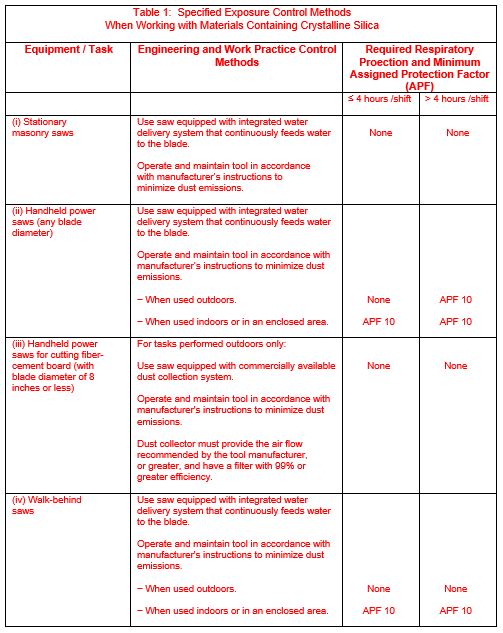
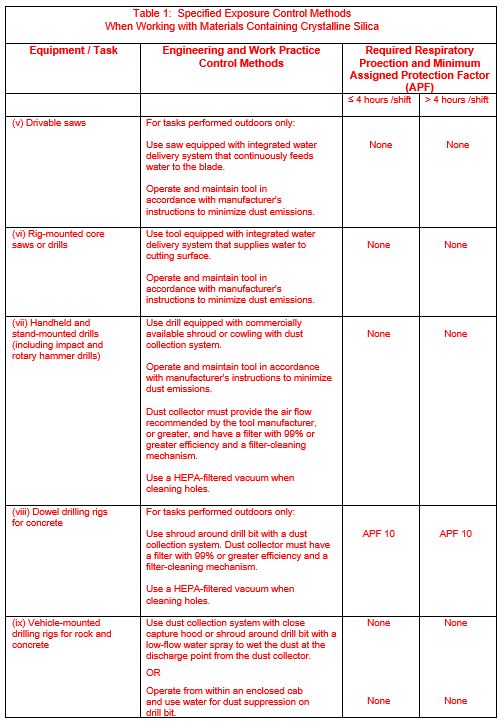
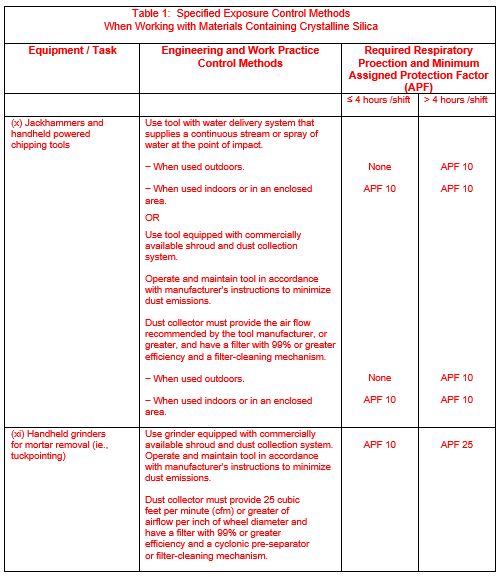
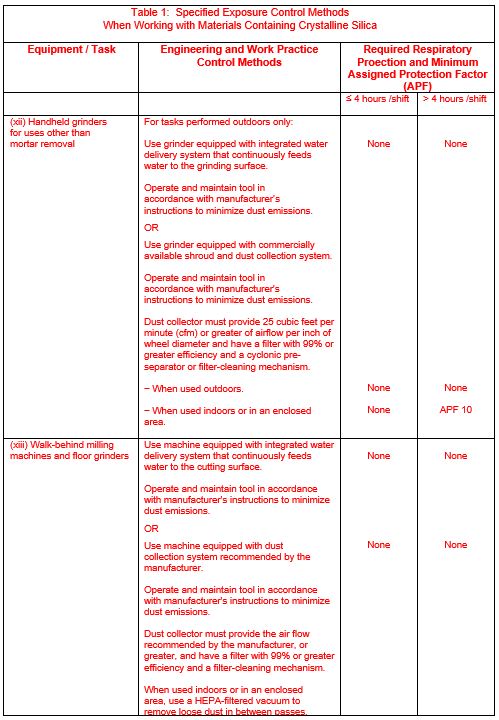
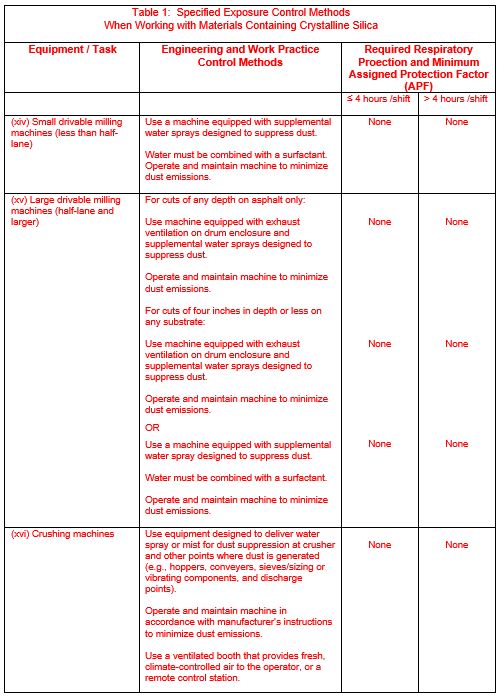
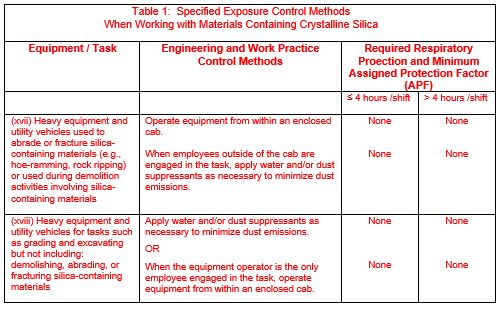
5.2 When implementing the control measures in Table 1, each employer shall:
5.2.1 For tasks performed indoors or in enclosed areas, provide a means of exhaust as needed to minimize the accumulation of visible airborne dust;
5.2.2 For tasks performed using wet methods, apply water at flow rates sufficient to minimize the release of visible dust.
5.2.3 For measures implemented that include an enclosed cab or booth, ensure that the enclosed cab or booth:
5.2.3.1 Is maintained as free as practicable from settled dust;
5.2.3.2 Has door seals and closing mechanisms that work properly;
5.2.3.3 Has gaskets and seals that are in good condition and working properly;
5.2.3.4 Is under positive pressure maintained through continuous delivery of fresh air;
5.2.3.5 Has intake air that is filtered through a filter that is 95% efficient in the 0.3-10.0 μm range (e.g., MERV-16 or better); and
5.2.3.6 Has heating and cooling capabilities.
5.3 Where an employee performs more than one task on Table 1 during a shift, and the total duration of all tasks combined is more than four hours, the required respiratory protection for each task is the respiratory protection specified for more than four hours per shift. If the total duration of all tasks on Table 1 combined is less than four hours, the required respiratory protection for each task is the respiratory protection specified for less than four hours per shift.
6.0 Alternative Exposure Control Methods
6.1 For tasks not listed in Table 1, or where the employer does not fully and properly implement the engineering controls, work practices, and respiratory protection described in Table 1:
6.1.1 Permissible exposure limit (PEL) – The employer shall ensure that no employee is exposed to an airborne concentration of respirable crystalline silica above 50 μg/m3, calculated as an 8-hour TWA.
6.1.2 Exposure assessment
6.1.2.1 The employer shall assess the exposure of each employee who is or may reasonably be expected to be exposed to respirable crystalline silica at or above the action level per either the performance option (6.1.2.2) or the scheduled monitoring option (6.1.2.3) of this section.
6.1.2.2 Performance option. The employer shall assess the 8-hour TWA exposure for each employee based on any combination of air monitoring data or objective data sufficient to accurately characterize employee exposures to respirable crystalline silica.
6.1.2.3 Scheduled monitoring option.
6.1.2.3.1 The employer shall perform initial monitoring to assess the 8-hour TWA exposure for each employee based on one or more personal breathing zone air samples that reflect the exposures of employees on each shift, for each job classification, in each work area.
6.1.2.3.2 If initial monitoring indicates that employee exposures are below the action level, the employer may discontinue monitoring for those employees whose exposures are represented by such monitoring.
6.1.2.3.3 Where the most recent exposure monitoring indicates that employee exposures are at or above the action level but at or below the PEL, the employer shall repeat such monitoring within six months of the most recent monitoring.
6.1.2.3.4 Where the most recent exposure monitoring indicates that employee exposures are above the PEL, the employer shall repeat such monitoring within three months of the most recent monitoring.
6.1.2.3.5 Where the most recent (non-initial) exposure monitoring indicates that employee exposures are below the action level, the employer shall repeat such monitoring within six months of the most recent monitoring until two consecutive measurements, taken seven or more days apart, are below the action level, at which time the employer may discontinue monitoring for those employees whose exposures are represented by such monitoring.
6.2 The employer shall reassess exposures whenever a change in the production, process, control equipment, personnel, or work practices may reasonably be expected to result in new or additional exposures at or above the action level, or when the employer has any reason to believe that new or additional exposures at or above the action level have occurred.
6.3 The employer shall ensure that all samples taken to satisfy the monitoring requirements as described above in this section are evaluated by a laboratory that analyzes air samples for respirable crystalline silica per the procedures in Appendix A to this section.
6.4 Employee notification of results
6.4.1 Within 5 workdays after making an exposure determination per Section 6.1 above, the Company shall individually notify each affected employee in writing of the results of that determination or post the results in an appropriate location accessible to all affected employees.
6.4.2 Whenever the exposure determination indicates that employee exposure is above the PEL, the employer shall describe in the written notification the corrective action being taken to reduce employee exposure to or below the PEL.
6.5 Where air monitoring is performed to comply with the requirements of this section, the employer shall provide affected employees or their designated representatives an opportunity to observe any monitoring of employee exposure to respirable crystalline silica.
6.5.1 When observation of monitoring requires entry into an area where the use of protective clothing or equipment is required for any workplace hazard, the employer shall provide the observer with protective clothing and equipment at no cost and shall ensure that the observer uses such clothing and equipment.
7.0 ENGINEERING AND WORK PRACTICE CONTROLS
7.1 The employer shall use engineering and work practice controls to reduce and maintain employee exposure to crystalline silica to or below the PEL unless the employer can demonstrate that such controls are not feasible. Lowering crystalline silica exposure can generally be accomplished by using common dust control methods, such as wetting down the work operations to keep silica-containing dust from getting into the air, enclosing the operation, or using a vacuum to collect dust at the point where it is created before the worker can inhale it.
7.2 Wherever feasible engineering and work practice controls are not sufficient to reduce employee exposure to or below the PEL, the employer shall use them to reduce employee exposure to the lowest levels achievable and shall supplement them by the use of respiratory protection that complies with the requirements of Section 8.0.
7.3 The employer shall not rotate employees to different jobs to achieve compliance with the PEL.
8.0 RESPIRATORY PROTECTION
8.1 Where respiratory protection is required by this section, the employer must provide each employee an appropriate respirator that complies with the requirements of this paragraph. The respirator must be selected based upon measured exposure levels and the assigned protection factors of the respirators.
8.2 Respiratory protection is required during:
8.2.1 Where specified in Table 1 of this procedure; or
8.2.2 For tasks not listed in Table 1, or where the employer does not fully and properly implement the engineering controls, work practices, and respiratory protection described in Table 1:
8.2.2.1 Where exposures exceed the PEL during periods necessary to install or implement feasible engineering and work practice controls;
8.2.2.2 Where exposures exceed the PEL during tasks, such as certain maintenance and repair tasks, for which engineering and work practice controls are not feasible; and
8.2.2.3 During tasks for which an employer has implemented all feasible engineering and work practice controls and such controls are not sufficient to reduce exposures to or below the PEL.
8.3 Respiratory Protection Program
8.3.1 Where respirator use is required by this procedure, the facility owner shall institute a respiratory protection program per the Respiratory Protection Standard, which covers each employee required to use a respirator.
8.0 PROTECTIVE WORK CLOTHING AND EQUIPMENT
8.1 Where exposure or potential exposure to crystalline silica is present, the facility owner shall provide appropriate personal protective clothing, such as coveralls, gloves, and eye protection, at no cost to employees, and shall ensure that employees use such clothing.
8.2 The facility owner shall ensure that employees remove all contaminated protective clothing and equipment at the end of the work shift or after their tasks involving crystalline silica, whichever comes first.
8.3 The facility owner shall ensure that no employee removes crystalline silica-contaminated protective clothing or equipment from the workplace, except for those employees whose job it is to launder, clean, maintain, or dispose of such clothing or equipment.
8.4 The removal of crystalline silica from protective clothing and equipment by blowing, shaking, or any other means that disperses the crystalline silica into the air or onto an employee’s body is strictly prohibited.
9.0 HYGIENE AREAS AND PRACTICES
9.1 Eating, drinking, smoking, and applying cosmetics shall be allowed in designated areas only and shall NOT be permissible in areas where crystalline silica is present.
9.2 The employer shall ensure that eating and drinking areas and surfaces are maintained as free as practicable of crystalline silica.
9.3 The employer shall ensure that employees do not enter eating and drinking areas with protective work clothing or equipment unless crystalline silica has been removed from the clothing and equipment by methods that do not disperse crystalline silica into the air or onto an employee’s body.
10.0 HOUSEKEEPING
10.1 The employer shall not allow dry sweeping or dry brushing where such activity could contribute to employee exposure to respirable crystalline silica unless wet sweeping, HEPA-filtered vacuuming or other methods that minimize the likelihood of exposure are not feasible.
10.2 The employer shall not allow compressed air to be used to clean clothing or surfaces where such activity could contribute to employee exposure to respirable crystalline silica unless:
10.2.1 The compressed air is used in conjunction with a ventilation system that effectively captures the dust cloud created by the compressed air; or
10.2.2 No alternative method is feasible.
11.0 WRITTEN EXPOSURE CONTROL PLAN
11.1 The employer shall establish and implement a written exposure control plan that contains at least the following elements:
11.1.1 A description of the tasks in the workplace that involve exposure to respirable crystalline silica;
11.1.2 A description of the engineering controls, work practices, and respiratory protection used to limit employee exposure to respirable crystalline silica for each task;
11.1.3 A description of the housekeeping measures used to limit employee exposure to respirable crystalline silica; and
11.1.4 A description of the procedures used to restrict access to work areas, when necessary, to minimize the number of employees exposed to respirable crystalline silica and their level of exposure, including exposures generated by other employers or sole proprietors
11.2 The employer shall review and evaluate the effectiveness of the written exposure control plan at least annually and update it as necessary.
11.3 The employer shall make the written exposure control plan readily available for examination and copying, upon request, to each employee covered by this section, their designated representatives, the Assistant Secretary and the Director.
11.4 The employer shall designate a competent person to make frequent and regular inspections of job sites, materials, and equipment to implement the written exposure control plan
12.0 MEDICAL SURVEILLANCE
12.1 The employer shall make medical surveillance available at no cost to the employee, and at a reasonable time and place, for each employee who will be required under this section to use a respirator for 30 or more days per year.
12.2 The employer shall ensure that all medical examinations and procedures required by this section are performed by a PLHCP (Physician or other licensed health-care professional).
12.3 The employer shall make available an initial (baseline) medical examination within 30 days after initial assignment unless the employee has received a medical examination that meets the requirements of this section within the last three years. The examination shall consist of:
12.3.1 A medical and work history, with emphasis on past, present, and anticipated exposure to respirable crystalline silica, dust, and other agents affecting the respiratory system; any history of respiratory system dysfunction, including signs and symptoms of respiratory disease (e.g., shortness of breath, cough, wheezing); the history of tuberculosis; and smoking status and history;
12.3.2 A physical examination with special emphasis on the respiratory system;
12.3.3 A chest X-ray (a single posteroanterior radiographic projection or radiograph of the chest at full inspiration recorded on either film (no less than 14 x 17 inches and no more than 16 x 17 inches) or digital radiography systems), interpreted and classified according to the International Labor Office (ILO) International Classification of Radiographs of Pneumoconiosis by a NIOSH-certified B Reader;
12.3.4 A pulmonary function test to include forced vital capacity (FVC) and forced expiratory volume in one second (FEV1) and FEV1/FVC ratio, administered by a spirometry technician with a current certificate from a NIOSH-approved spirometry course;
12.3.5 Testing for latent tuberculosis infection; and
12.3.6 Any other tests deemed appropriate by the PLHCP.
12.4 The employer shall make available medical examinations that include the procedures described in Section 12.3 above (except 12.3.5) at least every three years, or more frequently if recommended by the PLHCP.
12.5 The employer shall ensure that the examining PLHCP has a copy of this standard, and shall provide the PLHCP with the following information:
12.5.1 A description of the employee’s former, current, and anticipated duties as they relate to the employee’s occupational exposure to respirable crystalline silica;
12.5.2 The employee’s former, current, and anticipated levels of occupational exposure to respirable crystalline silica;
12.5.3 A description of any personal protective equipment used or to be used by the employee, including when and for how long the employee has used or will use that equipment; and
12.5.4 Information from records of employment-related medical examinations previously provided to the employee and currently within the control of the employer.
12.6 The employer shall ensure that the PLHCP explains to the employee the results of the medical examination and provides each employee with a written medical report within 30 days of each medical examination performed. The written report shall contain:
12.6.1 A statement indicating the results of the medical examination, including any medical condition(s) that would place the employee at increased risk of material impairment to health from exposure to respirable crystalline silica and any medical conditions that require further evaluation or treatment;
12.6.2 Any recommended limitations on the employee’s use of respirators;
12.6.3 Any recommended limitations on the employee’s exposure to respirable crystalline silica; and
6.1 A statement that the employee should be examined by a specialist if the chest X-ray provided is classified as 1/0 or higher by the B Reader, or if a referral to a specialist is otherwise deemed appropriate by the PLHCP.
13.0 HAZARD COMMUNICATION
13.1 The employer shall include respirable crystalline silica in the program established to comply with the hazard communication standard (29 CFR 1910.1200).
13.2 The employer shall ensure that each employee has access to labels on containers of crystalline silica and safety data sheets and is trained per 1910.1200.
13.3 The employer shall ensure that at least the following hazards are addressed: Cancer, lung effects, immune system effects, and kidney effects.
13.4 The employer shall make a copy of this procedure readily available to each employee.
14.0 EMPLOYEE INFORMATION AND TRAINING
14.1 The employer shall ensure that each employee covered by this section can demonstrate knowledge and understanding of at least the following:
14.1.1 The health hazards associated with exposure to respirable crystalline silica;
14.1.2 Specific tasks in the workplace that could result in exposure to respirable crystalline silica;
14.1.3 Specific measures the employer has implemented to protect employees from exposure to respirable crystalline silica, including engineering controls, work practices, and respirators to be used;
14.1.4 The contents of this procedure;
14.1.5 The identity of the competent person designated by the employer per Section 11.4 of this procedure; and
14.1.6 The purpose and a description of the medical surveillance program as required by this procedure.
15.0 RECORDKEEPING
15.1 The employer shall maintain an accurate record of all air monitoring conducted to comply with the requirements of this procedure.
15.2 This record shall include at least the following information:
15.2.1 The date of measurement for each sample taken;
15.2.2 The task monitored;
15.2.3 Sampling and analytical methods used;
15.2.4 Number, duration, and the results of samples taken;
15.2.5 Identity of the laboratory that performed the analysis;
15.2.5 Type of personal protective equipment, such as respirators worn; and
15.2.6 Name, social security number, and job classification of all employees represented by the monitoring, indicating which employees were monitored.
15.3 The employer shall maintain an accurate record for each employee covered by medical surveillance. The record shall include the following information about the employee:
15.3.1 Name and social security number;
15.3.2 A copy of the PLHCPs’ and specialists’ written medical opinions; and
15.3.3 A copy of the information provided to the PLHCPs and specialists.