Procedure 34 – ASSURED GROUNDING
REV. 5
Revision History
Revision
Date
Comments
1
04-01-91
General Revision
2
10-28-94
General Revision
3
10-20-00
General Revision
4
03-26-03
General Revision; added electronic links
5
03-16-12
Renumber and reformat procedure
1.0 PURPOSE
The purpose of this procedure is to provide written instructions for the use of all cord sets and receptacles that are not part of the permanent buildings or structures on job sites.
2.0 RESPONSIBILITY
It is the responsibility of the site manager to implement the requirements of this procedure and to make the procedure available at the site.
3.0 REFERENCES
29 CFR 1926.403
29 CFR 1926.404
29 CFR 1926.416
29 CFR 1926.449
4.0 DEFINITIONS
4.1 Fuse – An overcurrent protective device with a circuit opening fusible part that is heated and severed by the passage of overcurrent through it.
4.2 Ground – A conducting connection, whether intentional or accidental, between an electrical circuit or equipment and the earth, or to some conducting body that serves in place of the earth.
4.3 Ground-fault Circuit Interrupter – A device for the protection of personnel that functions to de-energize a circuit or portion of a circuit within an established period of time when a current to ground exceeds some predetermined value that is less than that required to operate the overcurrent protective device of the supply circuit.
4.4 Lighting Outlet – An outlet intended for the direct connection of a lamp holder, a lighting fixture, or a pendant cord terminating in a lamp holder.
4.5 Outlet – A point on the wiring systems at which current is taken to supply utilization equipment.
4.6 Qualified Person – One familiar with the construction and operation of the equipment and the hazards involved.
4.7 Receptacle – A receptacle is a contact device installed at the outlet for the connection of a single attachment plug.
4.8 Receptacle Outlet – An outlet where one or more receptacles are installed.
5.0 PROCEDURE
5.1 General Requirements
5.1.1 All electrical work shall be performed in accordance with the National Electrical Code.
5.1.2 No employee shall be allowed to work in such proximity to any part of an electric power circuit that the employee could contact the electric power circuit in the course of work, unless the employee is protected by de-energizing the circuit (see Lockout/Tagout Procedure) and grounding it or by guarding it effectively by insulation or other means.
5.1.3 In work areas where exact locations of underground electric power lines are unknown, employees using jackhammers, bars, or other hand tools which may contact a line shall be provided with insulated protective clothes.
5.1.4 Where an energized circuit exists, warning signs shall be posted and maintained. Employees shall be advised of the location of such circuits, the hazards involved, and the protective measures to be taken.
5.1.5 All portable electric tools should be equipped with or connected in unison with an approved ground-fault circuit interrupter.
5.2 Portable Cords and Cables
5.2.1 Electric cords or cables that are excessively worn or frayed shall not be used.
5.2.2 Extension cords shall not be fastened with staples, hung from nails, or suspended by wire.
5.2.3 Receptacles for attachment plugs shall be of an approved type and shall be so designed and constructed that the plug may be pulled out without leaving any live parts exposed to accidental contact.
5.2.4 Where different voltages, frequencies, or types of current (AC or DC) are to be supplied by portable cords, receptacles shall be of such design that attachment plugs used on these circuits are not interchangeable.
5.2.5 Attachment plugs or other connectors supplying equipment at more than 300 volts shall be of the skirted type or otherwise so designed that areas shall be confined.
5.2.6 Attachment plugs and bodies for use in work areas shall be so constructed that there are no exposed metal parts and shall endure rough use and be equipped with a suitable cord grip to prevent strain on the terminal screws.
5.2.7 Splicing of cords is prohibited unless cords are insulated equal to or better than original.
5.2.8 Extension cords shall be protected against damage as may be caused by traffic, sharp corners, projections, and pinching doors.
5.3 Test Requirements
5.3.1 Each cord set, attachment cap, plug and receptacle of cord sets and any equipment or tools connected by cord and plug, except for cord sets and receptacles that are fixed and not exposed to damage, shall be visually inspected before each day’s use for extended defects, such as deformed or missing pins, insulation damage and for indications of possible internal damage. Items found defective or damaged shall not be used until repaired.
5.3.2 All cord sets and receptacles that are not a part of the permanent wiring of the building or structure and cord-and-plug-connected equipment or tools that are required to be grounded shall be tested for the following:
5.3.2.1 All equipment grounding conductors shall be tested for continuity and shall be electrically continuous.
5.3.2.2 Each receptacle and attachment cap or plug shall be tested for the correct attachment for the equipment grounding conductor. The equipment grounding conductor shall be connected to its proper terminal.
5.3.3 All tests required shall be performed:
5.3.3.1 Before first use;
5.3.3.2 Before equipment or tools are used after any incident that can reasonably be suspected to have caused damage (such as when a cord set is run over);
5.3.3.3 Before equipment is returned to service following any repairs;
5.3.3.4 At intervals not to exceed 3 months, except for cord sets and receptacles that are fixed and not exposed to damage shall be tested at intervals not to exceed six (6) months.
6.0 ADDITIONAL REQUIREMENTS
6.1 In addition to this procedure, all safety precautions and guidelines of the manufacturer and each facility shall be followed.
7.0 ASSURED GROUNDING PROGRAM
7.1 Policy Statement
The procedure described herein is suitable for compliance with the requirements of an Assured Grounding Program as specified in OSHA and other applicable state codes. It is the policy of the Nitro Construction Services to implement an Assured Grounding Program when Ground Fault Circuit Interrupters are not practical. This policy will cover:
7.1.1 All plug in tools, cord sets, and receptacles that are not part of the permanent wiring of the building or structure.
7.1.2 All temporary light stringers used as extension cords for tools.
7.1.3 All individual temporary light stands if they are made of conductive material.
7.2 Designated Administrator of the Assured Grounding Test Program
Each project shall designate one person who will oversee and monitor the compliance with this requirement. The adequacy of the testing as well as the thoroughness will be monitored. The designated person for this project is
7.3 Test Procedure
A test for continuity shall be performed on all cord sets and receptacles that are not part of the permanent wiring and all plugin tools and equipment. A person or persons competent will do the testing and repair of these items either by training or experience.
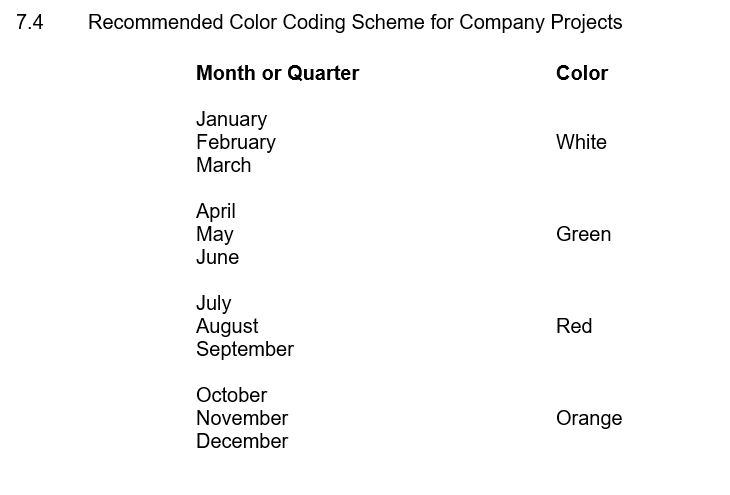
7.3.1 All electrical equipment and cord sets shall be inspected and tested before the first use for grounding continuity and correct wiring. If acceptable, such equipment and cords will be color-coded in accordance with the chart in this section to the corresponding quarter in which the test was performed.
7.3.2 Electrical tools, equipment, and cords returned to service after repairs shall be tested in accordance with 7.3.1.
7.3.3 All tools, electrical equipment, and cords will be visually inspected for damage in their entirety as part of the testing performed in 7.3.1.
7.3.4 All tools, electrical equipment, and cords are to be visually inspected before each use to ensure that there is no damage to the cord, plug, or tool body. The cord must display the proper color marking for the current quarter. The employee using the equipment or cord is responsible for assuring that it has the proper marking for the current quarter.
7.3.5 Any tool, cord set, or receptacle that is damaged or does not have proper color marking shall be reported to the supervisor by the employee who notices the problem immediately.