Procedure 42 – CRANE OPERATIONS
REV. 7
Revision History
Revision
Date
Comments
1
03-26-03
General Revision, added electronic links
2
12-14-09
General Revision
3
03-16-12
Renamed and reformat procedure
4
09-14-16
Revised Definitions and Daily Inspections (7.1.7)
5
10-10-17
Revised Set-Up Procedures, monthly inspection requirements, Manufacturer's documentation retention, signal person requirements
6
12-03-18
Revised – Critical Lift Requirements
7
09-28-20
Added Work History Form
1.0 PURPOSE
The purpose of this procedure is to establish guidelines sufficient to ensure that all cranes and mobile lifting devices operated by Nitro Construction Services will be operated safely and efficiently.
2.0 RESPONSIBILITY
It is the responsibility of the Site Manager/Superintendent to implement the requirements of this procedure.
3.0 REFERENCES
29 CFR 1910.180
29 CFR 1926.1400
ANSI B30.5
4.0 DEFINITIONS
4.1 Angle Indicator [Boom] – an accessory that measures the angle of the boom to the horizontal.
4.2 Base (mounting) – the traveling base or carrier on which the rotating superstructure is mounted such as a car, truck, crawlers, or wheel platform.
4.3 Boom – a member hinged to the front of the rotating superstructure with the outer end supported by ropes leading to a gantry or A-frame and used for supporting the hoisting tackle.
4.4 Boom Hoist – a hoist drum and rope reeving system used to raise and lower the boom. The rope system may be all live reeving or a combination of live reeving and pendants.
4.5 Boom Stop – a device used to limit the angle of the boom at the highest position.
4.6 Brake – a device used for stopping motion by friction or power means.
4.7 Cab – a housing that covers the rotating superstructure machinery and/or operator’s station. On truck-crane trucks, a separate cab covers the driver’s station.
4.8 Crawler crane – A rotating superstructure with a power plant, operating machinery, and boom, mounted on a base, equipped with crawler treads for travel.
4.9 Counterweight – a weight used to supplement the weight of the machine in providing stability for lifting working loads.
4.10 Dynamic (loading) – loads introduced into the machine or its components by forces in motion.
4.11 Gantry (A-frame) – a structural frame, extending above the superstructure, to which the boom support ropes are reeved.
4.12 Jib – an extension attached to the boom point to provide added boom length for lifting specified loads. The jib may be in line with the boom or offset to various angles.
4.13 Load (working) – the external load, in pounds, applied to the crane, including the weight of load-attaching equipment such as load blocks, shackles, and slings.
4.14 Load Block [upper] – the assembly of hook or shackle, swivel, sheaves, pins, and frame suspended from the boom point.
4.15 Load Block [lower] – the assembly of hook or shackle, swivel, sheaves, pins, and frame suspended by the hoisting ropes.
4.16 Load Hoist – a hoist drum and rope reeving system used for hoisting and lowering loads.
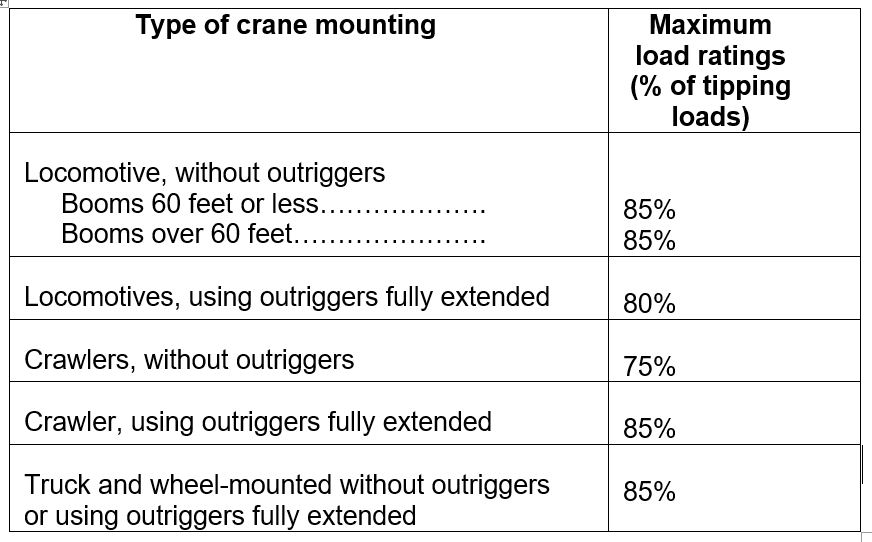
4.17 Load Ratings – crane ratings in pounds established by the manufacturer per the following:
4.17.1 The load ratings shall not exceed the following percentages for cranes:
4.18 Locomotive crane – A rotating superstructure with a power plant, operating machinery, and boom, mounted on a base or car equipped for travel on a railroad track.
4.19 Superstructure – the rotating upper frame structure of the machine and the operating machinery mounted thereon.
4.20 Truck crane – A rotating superstructure with a power plant, operating machinery, and boom, mounted on an automotive truck equipped with a power plant for travel.
4.21 Wheel-mounted crane – A rotating superstructure with a power plant, operating machinery, and boom, mounted on a base or platform equipped with axles and rubber-tired wheels for travel.
4.22 Outriggers – extendable or fixed metal arms, attached to the mounting base, which rest on supports at the outer ends.
4.23 Reeving – a rope system in which the rope travels around drums and sheaves.
4.24 Side Loading – a load applied at an angle to the vertical plane of the boom.
4.25 Structural Competence – the ability of the machine and its components to withstand the stresses imposed by applied loads.
4.26 Swing – the rotation of the superstructure for movement of loads in a horizontal direction about the axis of rotation.
4.27 Swing Mechanism – the machinery involved in providing rotation of the superstructure.
4.28 Tackle – an assembly of ropes and sheaves arranged for hoisting and pulling.
4.29 Transit – the moving or transporting of a crane from one job site to another.
4.30 Travel – the function of the machine moving from one location to another, on a job site.
4.31 Wheelbase – the distance between centers of the front and rear axles. For a multiple axle assembly, the axle center for wheelbase measurement is taken as the midpoint of the assembly.
5.0 PROCEDURE
5.1 Setting up
5.1.1 Before Setting up/ Assembling the Crane, the area must be inspected and verified to be stable ground and not have any underlying utilities that may be damaged because of operating the crane. Verify that the correct outrigger pads are used to support the weight of the crane and load and will distribute the weight as to not create a hazard of tipping, or damage underground utilities.
5.1.2 A Competent Person must be the lead contact when assembling or making setup changes to a crane. This person may be the Operator of the equipment or the owner. Ensure that the Manufacturer’s specifications are followed while setting up or assembling the crane. Verify all parts and pieces are secured in place before starting any work.
5.1.3 Any proposed Modification to the design of the crane must be approved by the equipment manufacturer (or Professional Engineer).
5.1.4 Ensure the area within the swing radius of the Crane is properly barricaded off, and that the barricade has the proper identification and information explaining the type of work being conducted.
5.2 Handling the load
5.2.1 No crane shall be loaded beyond the rated load, except for testing purposes.
5.2.2 When loads which are limited by structural competence rather than stability are to be handled, it shall be ascertained that the weight of the load has been determined within plus or minus 10 percent before it is lifted.
5.2.3 The Operator of the Crane has the ultimate authority to refuse to lift any load he/she deems unsafe and may continue with operations after all safety concerns are addressed. The Operator SHALL not make a lift until all affected employees are clear of the load and SHALL activate the horn if any employee is approaching the load.
5.3 Attaching the load
5.3.1 The hoist rope shall not be wrapped around the load.
5.3.2 The load shall be attached to the hook utilizing approved rigging devices.
5.4 Moving the load
5.4.1 The crane shall be level and where necessary blocked properly.
5.4.2 The load shall be well secured and properly balanced in the sling or lifting device before it is lifted more than a few inches.
5.4.3 Before starting the hoist, the following conditions shall be noted:
5.3.3.1 Hoist rope shall not be kinked.
5.3.3.2 Multiple part lines shall not be twisted around each other.
5.3.3.3 The hook shall be brought over the load in such a manner as to prevent swinging.
5.4.4 During hoisting care shall be taken that:
5.3.4.1 There is no sudden acceleration or deceleration of the moving load.
5.3.4.2 The load does not contact any obstructions.
5.4.5 Sideloading of booms shall be limited to freely suspended loads. Cranes shall not be used for dragging loads sideways.
5.4.6 No hoisting, lowering, swinging, or traveling shall be done while anyone is on the load or hook.
5.4.7 The operator SHALL NOT carry loads over people.
5.5 Holding the load
5.5.1 The operator shall not be permitted to leave his position at the controls while the load is suspended.
5.5.2 No person shall be permitted to stand or pass under a load on the hook.
5.5.3 If the load must remain suspended for any considerable length of time, the operator shall hold the drum from rotating in the lowering direction by activating the positive controllable means of the operator’s station.
5.6 Other requirements
5.6.1 Hand Signal Chart
5.6.1.1 Hand signal chart (NCS Form 025) must either be posted on the equipment or conspicuously posted in the vicinity of the hoisting operations.
5.6.2 Cabs
5.5.2.1 Necessary clothing and personal belongings shall be stored in such a manner as to not interfere with access or operation.
5.5.2.2 Tools, oil cans, waste, extra fuses, and other necessary articles shall be stored in the toolbox and shall not be permitted to lie loose in or about the cab.
5.5.2.3 The cab shall be equipped with a load rating chart matching the crane that it is in as well as the manufacturer’s operations manual.
5.6.3 Refueling
5.5.3.1 Refueling with small portable containers shall be done with an approved safety type that can be equipped with an automatic closing cap and flame arrester.
5.5.3.2 Cranes shall not be refueled with the engine running.
5.6.4 Fire Extinguishers
5.5.4.1 A carbon dioxide, dry chemical, or equivalent fire extinguisher shall be kept in the cab or vicinity of the crane.
5.5.4.2 Operating and maintenance personnel shall be made familiar with the use and care of the fire extinguisher provided.
5.6.5 Operations near overhead lines
5.6.5.1 If work is to be performed near overhead lines, the lines shall be de-energized and grounded, or other protective measures shall be provided before work is started.
5.6.5.2 If the lines are to be de-energized, arrangements shall be made with the person or organization that operates or controls the electricity involved to de-energize and ground the energy.
5.6.5.3 If protective measures, such as guarding, isolating, or insulating, are provided, these precautions shall prevent employees from contacting such lines directly with any part of their body or indirectly through conductive materials, tools, or equipment.
5.6.6 Safety Devices
5.5.6.1 All safety devices shall be functional and not circumvented without written permission from the engineering (if applicable) and EHS departments. This shall include anti-two-blocking devices.
5.5.7 Rail Clamps
5.5.7.1 Rail clamps shall not be used as a means of restraining the tipping of a locomotive crane.
5.5.8 Ballast or Counterweight
5.5.8.1 Cranes shall not be operated without the full amount of any ballast or counterweight in place as specified by the maker, but truck cranes that have dropped the ballast or counterweight may be operated temporarily with special care and only for light loads without full ballast or counterweight in place.
5.5.8.2 The ballast or counterweight specified by the manufacturer shall not be exceeded.
6.0 OPERATOR QUALIFICATIONS
The employer must ensure that before operating any equipment covered under this procedure, the person is operating the equipment during a training period following paragraph (f) of 1926.1427 or is qualified or certified to operating the equipment. The certification must comply with one of the options below:
6.1 Certification by an accredited crane operator testing organization
6.1.1 The testing organization must be accredited by a nationally recognized accrediting agency and have its accreditation reviewed by the nationally recognized accrediting agency at least every three years.
6.1.2 An operator will be deemed qualified to operate a particular piece of equipment if the operator is certified under paragraph (b) of 29 CFR 1926.1427 for that type and capacity of equipment or for higher-capacity equipment of that type. The operator’s certificate must state the type/capacity of equipment for which the operator is certified.
6.1.3 A certification issued under 29 CFR 1926.1427 is valid for a period determined by the certifying entity not to exceed 5 years.
7.0 SIGNAL PERSON QUALIFICATIONS
The employer of the signal person must ensure that each signal person meets the Qualification Requirements, as described in 29 CFR 1926.1428 before giving any signals. This requirement must be met by using either Option (1) or Option (2) of this section.
7.1 Option (1)-Third-party qualified evaluator. The signal person has documentation from a
third-party qualified evaluator showing that the signal person meets the Qualification Requirements.
7.2 Option (2–Employer’s qualified evaluator. The employer’s qualified evaluator assesses the individual and determines that the individual meets the Qualification Requirements and provides documentation of that determination. An assessment by an employer’s qualified evaluator under this option is not portable–other employers are not permitted to use it to meet the requirements of this section.
7.3 The employer must make the documentation for whichever option is used, available at the site while the signal person is employed by the employer. The documentation must specify each type of signaling (e.g. hand signals, radio signals, etc.) for which the signal person meets the requirements.
7.3.1 If subsequent actions by the signal person indicate that the individual does not meet the Qualification Requirements, the employer must not allow the individual to continue working as a signal person until re-training is provided and a re-assessment is made following the above-described evaluation that confirms that the individual meets the Qualification Requirements.
7.4 QUALIFICATION REQUIREMENTS
7.4.1 Each signal person must:
7.4.1.1 Know and understand the type of signals used. If hand signals are used, the signal person must know and understand the Standard Method for hand signals.
7.4.1.2 Be competent in the application of the type of signals used.
7.4.1.3 Have a basic understanding of equipment operation and limitations, including the crane dynamics involved in swinging and stopping loads and boom deflection from hoisting loads.
7.4.1.4 Know and understand the relevant requirements of § 1926.1419
through § 1926.1422 and § 1926.1428.
7.4.1.5 Demonstrate that he/she meets the above-described requirements
through an oral or written test, and through a practical test.
8.0 QUALIFIED RIGGER REQUIREMENTS
A qualified rigger is a rigger who meets the criteria for a qualified person. Nitro Construction Services must determine whether a person is qualified to perform specific rigging tasks. Each qualified rigger may have different credentials or experience.
8.1 A qualified rigger.
8.1.1 Possesses a recognized degree, certificate, or professional standing.
8.1.2 Has extensive knowledge, training, and experience, and can successfully demonstrate the ability to solve problems related to rigging loads.
8.2 The person designated as the qualified rigger must have the ability to properly rig the load for a job.
8.3 Nitro Construction Services, must ensure the person can do the rigging work
needed for the exact types of loads and lifts for a job with the equipment and rigging
that will be used for that job.
8.5 CERTIFIED RIGGER REQUIREMENTS
A certified rigger is a rigger who meets the criteria for a certified person. Nitro Construction Services must determine whether a person is qualified to perform specific rigging tasks. Each certified rigger may have different credentials or experience.
8.1 A certified rigger is a person that:
8.1.1 Possesses a recognized degree, certificate, or professional standing, or 8.1.2 Has extensive knowledge, training, and experience, and
8.1.3 Can successfully demonstrate the ability to solve problems related to
rigging loads.
8.2 The person designated as the certified rigger must have the ability to properly rig the load for a
critical lift.
8.3 Nitro Construction Services, must ensure the person can do the rigging work needed for the exact types of loads and lifts for a particular job with the equipment and rigging that will be used for that job.
9.0 INSPECTIONS
9.1 Daily Inspection
Items such as the following shall be inspected for defects including observation during operation for any defects. Any deficiencies such as listed shall be carefully examined and determination made as to whether they constitute a safety hazard.
9.1.1 All control mechanisms for maladjustment interfering with proper operation.
9.1.2 All safety devices for malfunction.
9.1.3 Deterioration or leakage in the air or hydraulic systems.
9.1.4 Moving parts, gears, drums, shafts, and belts adequately screened or guarded.
9.1.5 Chords and lacing for acceptable conditions.
9.1.6 Crane hooks for deformation and cracks.
9.1.7 Rope reeving for noncompliance with the manufacturer’s recommendations.
9.1.8 Check the following items for proper function:
7.1.7.1 Hoist brakes
7.1.7.2 Clutches
7.1.7.3 Operating levers
9.1.9 Inspect electrical apparatus for:
7.1.8.1 Malfunction
7.1.8.2 Signs of excessive deterioration
7.1.8.3 Dirt accumulation
7.1.8.4 Moisture accumulation
9.1.10 Utilize the Crane Inspection Checklist (NCS Form 026) or equivalent form to document inspection.
9.2 Monthly Inspections
Monthly Inspections must be conducted by a competent person covering the above-listed items for the daily inspections. The daily inspection records shall be retained for 3 months in place of the Monthly Inspection records.
9.3 Annual/Comprehensive Inspection
9.3.1 At least every 12 months the equipment must be inspected by a qualified person following 29 CFR 1926.1412(f)(1) and 1926.1412(f)(2).
10.0 GENERAL LIFT CONSIDERATIONS
10.1 Lift Plan
10.1.1 A lift plan shall be conducted before making any lift. This can consist of a JSA detailing the lift.
10.1.2 The Lift Plan shall identify the work zone and any hazards in the area that may impact the operation of the crane. See 29 CFR 1926.1408 Table A
10.2 Single lift plan considerations:
10.2.1 Lift is less than 75% of crane chart
10.2.2 Lift has no complication as to physical clearances
10.2.3 Does not require a special, or complex rigging
11.0 CRITICAL LIFTS
THE CRITICAL LIFT PERMIT AND VERIFICATION FORM, WITH ATTACHMENTS, SHEET MUST BE COMPLETED BEFORE PERFORMING THE CRITICAL LIFT.
11.1 The decision to designate any crane lift as a critical lift is a Nitro Construction Services management decision. Guidelines provided here are intended to aid in making that decision. A lift should be designated as a critical lift if any of the following situations are present:
11.1.1 Any lift involving multiple cranes
11.1.2 Any single crane or hoist lift of 10 ton or more
11.1.3 Any lift which exceeds 75% of crane chart
11.1.4 Any lift which involves lifting from a barge, or other inherently unstable objects.
11.1.5 The load weight cannot be accurately verified
11.1.6 The load is of uneven proportion, requiring complex rigging techniques
11.1.7 The load is located in a position that does not allow easy egress of personnel in the area (i.e. employees are at height, in a confined area, etc..)
11.1.8 An incident would result in personnel injury or significant adverse health impact, either onsite or offsite
11.1.9 An incident would result in damage that would result in an unacceptable delay to schedule or other significant consequence to the progress of the job
11.1.10 An incident would result in undetectable damage that would jeopardize future operations or safety of a facility
11.1.11 An incident would result in a significant release of radioactive or other hazardous material to the environment or creation of an undesirable condition
11.1.12 An incident would result in damage that would result in serious economic consequences
11.1.13 The item, although non-critical, requires exceptional care in handling because it is being lifted above a critical item (e.g. process piping or pipe racks or energized high voltage)
11.2 Signalperson and Communications
11.2.1 Ensure a Qualified Signal Person is used when the Operators View is Obstructed. Use communication methods such as radios or signal persons to relay instructions. If communication is interrupted at any point in time while the crane is in operation, the crane operator shall safely stop the operation of the crane until communication is reestablished. A signal person may become qualified by the following:
11.2.2 The signal person has documentation from a third-party qualified evaluator. 11.2.3 A Nitro qualified evaluator assesses the individual and determines that the individual meets the Qualification Requirements
11.2.4 When a Qualified Signal Person is utilized, only one individual shall relay commands to the crane operator at any time. The only instance that any individual may signal the crane operator, is if an emergency would occur.
11.2.5 Prior to beginning crane operations, all communication methods must be tested. Radios shall be tested and checked to ensure a full battery is available. Signal persons shall move to positions to check that a clear line of site is maintained with the operator.
12.0 RECORDKEEPING
12.1 Copies of operator qualifications and/or testing results to be kept on sight in the personnel file.
12.2 Documentation of periodic inspections (monthly minimum) (NCS Form 026) shall be kept on file at the job site and shall include the following:
12.2.1 Inspection records on critical components including brakes, crane hooks, and ropes. All ropes must be certified for use if the crane has been shut down or stored for any length of time. This applies when the rope has been changed whether new or previously used.
12.2.2 There must be a record kept by date of inspection, an ID of the rope inspected, and signature of the person performing the monthly or start-up inspection.
12.2.3 Records indicating load test results and subsequent repairs or alterations.
12.2.4 Records indicating cab supplied with fully charged fire extinguisher and appropriate and legible load chart.
12.3 Each operator’s file shall contain a list of equipment that the operator is qualified to operate.
13.0 APPENDICES
13.1 NCS Form 025 – Standard Hand Signals
13.2 NCS Form 026 – Crane Inspection Form
13.3 NCS Form 027 – Critical Lift Permit Verification
13.4 NCS Form 029 – Critical Lift Permit
13.5 29 CFR 1926.1408 Table A – Working clearance from energized lines
13.6 NCS Form 057 – Work History Form