Procedure 61 – FATIGUE MANAGEMENT PLAN
REV. 2
Revision History
Revision
Date
Comments
1
09-01-12
Initial Issue
1
10-10-17
Procedure Review
5.17 PURPOSE
To guide identifying and assessing employee fatigue risk and identifying appropriate control measures to minimize fatigue for employees due to working long hours per day, working for extended periods, working call outs and holdovers, performing physically or mentally demanding tasks, working in extreme environmental conditions or performing work with exposures to other factors which place employees at higher risk for fatigue.
5.18 SCOPE
This procedure applies to Nitro Construction Services employees working in those refineries, petrochemical, and chemical operations, natural gas liquefaction plants and other facilities such as those covered by the OSHA Process Safety Management Standard, 29 CFR 1910.119, who have adopted the RP-755 (Fatigue Risk Management Systems for Personnel in the Petroleum and Petrochemical Industries).
5.19 REFERENCES
Guidance – API-RP-755, Fatigue Risk Management System for Personnel in the Refining and Petrochemical Industries, April 2010
4.0 DEFINITIONS
4.1 Call Out – Summoning an employee to the worksite to perform work that he/she was not scheduled to perform and is outside of scheduled work hours that may interrupt normal sleep time.
4.2 Extended Shift – Time an employee is assigned to work that extends outside their regularly scheduled shift hours and into other shifts.
4.3 Fatigue – Reduced mental and/or physical functioning caused by sleep deprivation and/or being awake during normal sleep hours. This may result from extended work hours, insufficient opportunities for sleep, failure to use available sleep opportunities, or the effects of sleep disorders, medical conditions, or pharmaceuticals which reduce sleep on increase sleepiness.
4.4 Fitness for Duty – the ability of the employee to safely perform his/her job without risk to themselves, others, community, environmental, or property.
4.5 Holdovers – A periodic, occasional extended shift, where employees are at work beyond their regular shift to participate in training, safety meetings, and the like. This does not include the time needed for normal shift handover.
4.6 Normal Operations – Operations that are not during outages.
4.7 Open Shift – Foreseeable or planned vacancies where the vacancy is known at least one week in advance and over time will be required to fill the vacancy (non-emergency).
4.8 Outages – Planned or unplanned interruption in the normal operations of a unit or plant including mobilizing and de-mobilizing. Outages include but are not limited to, such things as turnarounds, unit shutdowns, operational responses, etc.
4.9 Shift Work – An organization of work patterns where workers succeed each other at the same workplace while performing similar operations at a different time of the day thus allowing longer hours of operations than feasible for a single worker.
4.10 Work Sets – Consecutive shifts with a minimum of 36 hours off before starting another work set.
5.0 RESPONSIBILITIES
5.1 Project Manager
5.1.1 Ensure the Nitro Construction Services site employees are not adversely affected by fatigue due to excessive work hours, lack of suitable rest and recovery periods, exposure to extreme environmental conditions, or other factors.
5.1.2 Conduct a Fatigue Employee Awareness Checklist utilizing NCS Form 042 whenever hours exceed the recommendations listed in Section 6.3 (Hours of Service Limits).
5.1.3 Document the fatigue risk assessment utilizing NCS Form 042 – Fatigue Awareness Employee Checklist.
5.1.4 Implement actions to mitigate fatigue risk to personnel, such as providing for suitable transportation to reduce worker fatigue, adjusting work shift hours, including transportation hours in the calculation of the overall work schedule hours, adjusting daily shift length, adjusting work activities within the work schedule or site roster.
5.2 Management and Supervision
5.2.1 Review Fatigue Risk Assessment and implement actions to mitigate fatigue risk to personnel (as listed in Section 5.1.4).
5.2.2 Encourage individuals to be continuously aware of their level of fatigue.
5.2.3 Take appropriate actions including adjusting work hours to ensure employees receive adequate rest.
5.3 Corporate Safety Director
5.3.1 Support the fatigue risk assessment process.
5.3.2 Facilitate the fatigue analysis process by:
5.3.2.1 Performing and/or participating in the development of project-level fatigue analysis.
5.3.2.2 Provide training in the fatigue risk assessment process.
5.3.2.3 Monitor the effectiveness of the fatigue management plan.
5.4 Employees
5.4.1 Be continuously aware of an employee’s level of fatigue and take appropriate steps to enhance their alertness while on duty.
5.4.2 Report to supervisor if they determine they are too fatigued to work safely or may not be fit for duty for any other reason.
5.4.3 Report to supervisors when they observe a co-worker or other individuals exhibiting behaviors that show they may not be fit for duty.
.
6.0 PROCEDURE
6.1 Individual Risk Assessment and Mitigation
6.1.1 If and when an individual determines that they are too fatigued to work safely, they shall report this to their supervisor.
6.1.2 Individuals working shift work and others who may be involved in working extended hours during plant outages should use their time off the job to get appropriate sleep and maintain their alertness and fitness for duty.
6.1.3 Supervisors shall be alert to signs of excessive fatigue in employees and contractors.
6.1.4 Supervisors shall provide and ensure employees are using the most Ergonomically friendly tools and equipment as deemed reasonably appropriate.
6.2 Incident/Near Miss Investigation
6.2.1 Investigation of incidents shall be conducted in a manner that facilitates the determination of the role if any, of fatigue as a root cause or contributing factor of the incident.
6.2.2 Information collected should include the time of the incident, number of consecutive shifts worked, number of hours awake, shift duration (any overtime worked), whether the incident occurred under normal operations or an extended shift, and other fatigue factors.
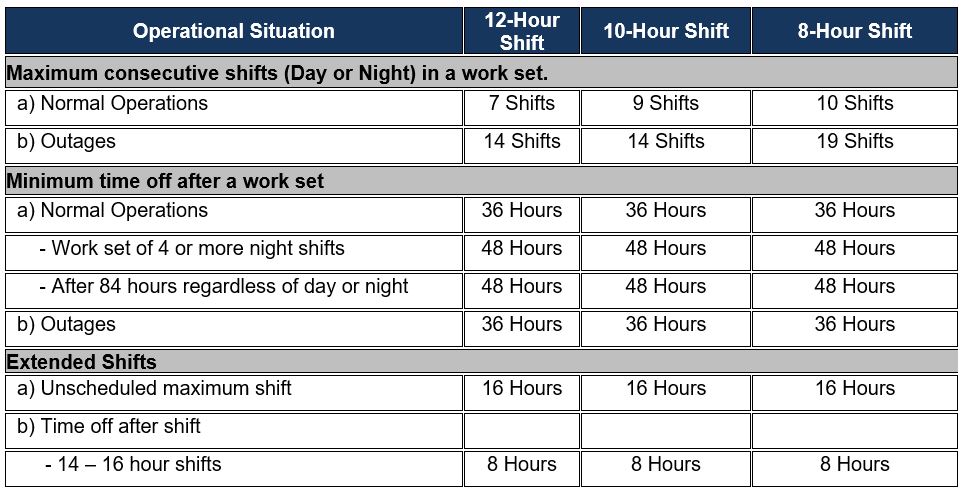
6.3 Hours of Service Limits
6.3.1 The hours listed below specify the service limits that shall not be exceeded.
6.3.2 If the limits cannot be followed, the Fatigue Awareness Employee Checklist (NCS Form 042) shall be completed.
6.3.3 Employees shall be provided designated areas where they can take rest breaks through the course of their work shift.
7.0 TRAINING
7.1 Training shall be provided to employees and managers to educate on the causes, risks, and potential consequences of fatigue.
7.2 All employee should receive initial and recurring training (3 years) that includes:
7.2.1 General awareness regarding the signs and symptoms of fatigue and other fitness for duty concerns;
7.2.2 Workplace safety and health responsibilities in the workplace;
7.2.3 Risk factors associated with the onset of fatigue in the workplace.
7.2.4 The body’s biological clock and its effects.
7.2.5 Control measures to prevent and reduce fatigue.
7.2.6 Responsibility of employees to rest during their rest days; and
7.2.7 Fitness for duty on work shifts.
7.3 Supervisors and Managers should additionally receive initial and refresher training that includes the following:
7.3.1 The influence of staffing levels on employee fatigue;
7.3.2 The effects of work and rest scheduling on employee fatigue and how to schedule work to minimize the risk;
7.3.3 How to detect when employees are excessively fatigued;
7.3.4 Understanding policies and procedures for times when employees or contractors should be removed from duty due to fatigue.
8.0 APPENDICES/TABLES
5.20 NCS Form 042 – Fatigue Awareness Employee Checklist