Procedure 70 – Mechanical Equipment Operations Near Energized Lines
REV. 2
Revision History
Revision
Date
Comments
1
10-30-17
Initial Issue
2
04-29-20
Revision to referenced Table A
1.0 PURPOSE
The purpose of this program is to set forth procedures for safe work being performed on or near
energized lines by Nitro Construction Services employees.
2.0 SCOPE
This program applies to all Nitro employees, temporary employees, and sub-contractors. When work is
performed on a non-owned or operated site, the operator’s program shall take precedence,
however, this document covers Nitro employees and sub-contractors and shall be used on own
premises, or when an operator’s program does not exist or is less stringent.
3.0 RESPONSIBILITY
3.1 The site manager or their, qualified designee, is responsible for the implementation of this procedure. The site manager or their, qualified designee, will also be responsible to assure that this procedure is made available to all employees to which this policy applies.
4.0 PROCEDURE
4.1 Minimum Approach Distances
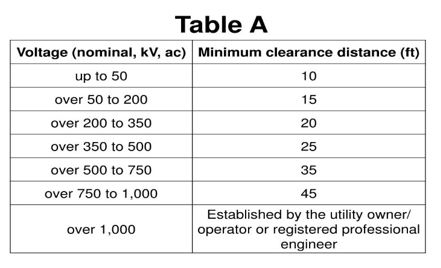
Mechanical equipment is operated so the minimum approach distances of Table R-6 through Table R-10 of 29CFR 1910.269, are maintained.
4.1.1 Table A in 1926.1408
4.2 Protection from Hazards
4.2.1 All employees shall be protected from hazards associated with equipment encountering the energized lines. The measures used shall ensure that the employees will not be exposed to hazardous differences in potential unless Nitro Construction Services can demonstrate that the methods in use, protect all employees from the hazards that might arise if the equipment contacts the energized line.
4.3 Mechanical Equipment Load Limits
4.3.1 Ensure mechanical equipment load limits/ratings are adhered to. Mechanical equipment used to lift or move lines or other material shall be used within its maximum load rating and other design limitations for the conditions under which the work is being performed.
4.4 Insulating Material
4.4.1 The energized line(s) shall be covered with an insulating material that will withstand the type of contact that may be made during the operation of mechanical equipment.
4.5 Shift Inspections
4.5.1 Critical components of mechanical elevating and rotating equipment shall be inspected before use on each shift. The critical safety components of mechanical elevating and rotating equipment shall receive ta thorough visual inspection before use on each shift. Note: Critical safety components of mechanical elevating and rotating equipment are components whose failure would result in a free fall or rotation of the boom.
4.6 Obstructed Views
4.6.1 Equipment with obstructed views shall utilize a spotter or reverse signal alarm audible above the surrounding noise level. No motor vehicle, earthmoving, or compacting equipment having an obstructed view may be operated on off-highway job sites where an employee is exposed to the hazards created by the moving vehicles unless:
4.6.1.1 The vehicle has a reverse signal alarm audible above the surrounding noise level.
4.6.1.2 The vehicle only moves when a designated spotter signals that it is safe to do so.
4.7 Designated Spotter
4.7.1 A designated employee (spotter) shall observe the approach distance and provide timely warning to the operator if approach distances are compromised required by 29CFR 1926.1408 Table A.
4.8 Training
4.8.1 Employees will receive training on the contents of this procedure before performing any work on or near energized lines. Training shall be documented and retained in the employees’ training file.